Dominate the court and improve your game in just one click and from home.

The best 100% online program for players of all levels. You will learn about technique and tactics, match situations, score analysis and sports psychology. All of this with the objective of raising your level of play, mastering technique and improving your results in matches.

0 %

online with a methodology based on microlearning

+ 0

lessons in audiovisual format

14

technique, tactics, psychology and research modules

+ 0 K

players trained with Padelmba

Who are these certifications for?

01/

PLAYERS OF ALL LEVELS

From beginner to advanced, improve all areas of your game with guided sessions, drills and on-court tips to improve your performance in training and competitions.

02/

TRAINERS AND PROFESSIONALS

For those who also want to grow as players: update technique and tactics, structure sessions with criteria and transfer methodologies to your students to improve measurable results.

03/

PADDLE FANS

Take your first steps with clear fundamentals, training habits and vision of the ecosystem: clubs, roles and management models, to integrate and progress successfully in this new adventure to begin.
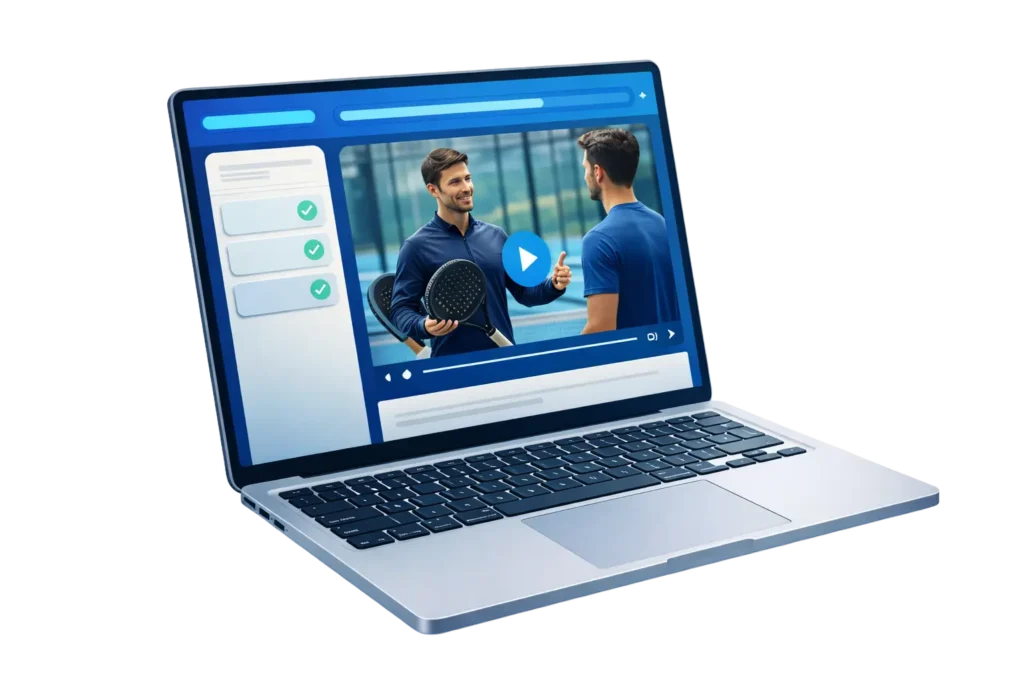
Improve your on-court game with the help of top professionals

100% online training

Designed in microlearning so you can progress at your own pace. Get full access to the course with more than 80 lessons, get achievement badges as you progress and enjoy lifetime access to review whenever you want. Ideal for consolidating training habits and improving on the track with a practical and motivating experience.

99€
What contents are included in the course?

  1. Keys to hit better shots without a wall from the back of the court.
  2. How to improve wall bounce shots with control and depth.
  3. The three forgotten ones: look at the ball, use the non-dominant hand and keep the right attitude.
  4. Positioning on the court to attack, defend and transition efficiently.
  5. Choosing your racket: practical criteria to get it right according to your level and style of play.
  6. How the grip conditions your game and what adjustments to apply.
  7. Keys to execute a safe balloon with the right height/direction.
  8. Influence of grip and grips on your performance and recommendations for progress.
  1. Make the serve draw correctly and warm up well before playing.
  2. Master your serve to start every point with an advantage.
  3. Improve your remains by knowing their technical keys.
  4. Apply tactics in your serve to direct the game and dominate the match.
  5. Optimize your rest by incorporating effective tactical principles.
  6. Learn how to play in Australian formation: when to use it and how to execute it.
  7. Don't know which side to play on? Identify your best side to maximize your advantage.
  8. Achieve total control of the serve: direction, spin and consistency.
  1. Tips for reading and hitting back wall rebounds.
  2. Learn the technical details to improve your wall rebounds.
  3. Learn to read the ball and recognize double walls.
  4. React to your opponent's shot and perform a counterattack to recover the ball.
  5. Master the wall descent and the technical keys necessary to execute it.
  6. Play in tune: learn to move with your partner at the back of the court.
  7. Improve as a player by mastering footwork on the court.
  1. Learn to volley backhand on both sides of the court.
  2. Knows the technical keys of the set up and the point of contact in the volley.
  3. Correctly position the feet in the volley and add energy to the movement.
  4. Smash the ball on the volley so that it bounces as little as possible.
  5. He uses the drop shot in the match and closes the point.
  6. How to defend and attack on the fence effectively.
  7. Learn to volley forehand on both sides of the court.
  8. Discover the best placement at the net: distance, angles and tilting with your partner.

  1. Execute the perfect tray by applying the technical keys.
  2. Learn how to perform the slam dunk in threes.
  3. He gets the ball out for four in the game.
  4. Performs a powerful and well-directed shot.
  5. Learn how to make the jumping tray.
  6. It dominates the viper as a finishing resource.
  7. It executes the “grille” or "curl" backtack.
  8. Apply tactical tips to improve your tray
  1. What is laterality?
  2. How laterality influences the game - Part 1.
  3. How laterality influences the game - Part 2.
  4. Analyzes the technical-tactical characteristics - Part 1.
  5. Analyzes the technical-tactical characteristics - Part 2.
  6. Analyzes the technical-tactical characteristics - Part 3.
  7. Analyzes the technical-tactical characteristics - Part 4.
    1. Introduction to tactical concepts to prepare for a match.
    2. The importance of the serve in deciding the outcome of a game.
    3. Understanding the first volley in the match.
    4. The importance of the rest.
    5. What to do during the “mid-game”.
    6. How to get out of compromising moves.
    1. If you don't know where to stand, use the traffic light technique.
    2. Don't know where to direct your serve? We help you to make your opponent's rest more difficult.
    3. Learn to direct your return according to the type of serve of your opponent.
    4. Analyze your subtraction mistakes and learn from them.
    5. Play the first volley depending on the situation you are in.
    6. Correct and improve your volley by identifying the most common errors.
    7. Dominates the court with effective aerial shots.
    8. Executes the layup and smash to perfection.
  1. Learn how to execute the serve in any game situation.
  2. Subtract taking into account the game situation and your partner.
  3. Perfect your defense: play balloons judiciously and effectively.
  4. Counterattack and beat your opponent when he is at the net.
  5. Where to volley after the serve? Learn how to make the right decision.
  6. Master your positioning on the court when facing a wall descent.
  7. Use each type of smash correctly according to the play.
  8. How to receive a shot from the opponent? Techniques and response options.
  1. Is your opponent or partner left-handed? Learn how to play and coordinate with him.
  2. Is the game getting complicated? Reset and recover sensations to turn it around.
  3. How to beat a defensive player: patterns and key decisions.
  4. Are you facing an aggressive player? Strategies to neutralize his rhythm and win.
  5. Play as a team and become a winning pair.
  6. Do they “refrigerate” you? Get out of it with these tactical and positioning tips.
  7. Detect your opponents' weak points and turn them into game opportunities.
  8. Improve your communication with any partner, even if you have just met.
    1. Introduction to PADEL MASTER.
    2. We review what is paddle tennis.
    3. Coming from tennis? Easily switch to paddle tennis.
    4. Learn the fundamental concepts about paddle tennis.
    5. Strategies to begin to understand the game.
    6. Learn the important aspects of each wall rebound.
    7. Get to know the best counterattack strategies.
    8. Find out everything you need to know about the volley.
    9. He masters the technical aspects of aerial play.
    10. Technical keys to the serve and the rest.
    11. Learn how to create your own attack strategies.
    12. How to plan a match.
  1. Control how your mind influences.
  2. Put into practice the keys to become active and develop your mental strength.
  3. Boost your performance through your beliefs.
  4. Harness your motivation to improve as a player by planning goals.
  5. Apply the benefits of self-dialogue and sports priming.
  6. Win your matches using resources such as mental imagery and pre-competitive routines.
  7. Learn to make decisions taking all factors into account.
  8. Focus, put your focus and go all out in the match.
  1. Justification, advantages and analysis.
  2. Performance analysis in paddle tennis.
  3. Game actions.
  4. Player movements and scoreboard analysis.
  5. Physiological parameters, body composition and anthropometry in paddle tennis.
  6. Physical condition and injuries in paddle tennis.
  7. Technique, biomechanics and training methodology in paddle.
  8. Psychology and other scientific areas in padel.
  1. Definition of performance indicators in paddle tennis.
  2. Preparation of reports to players based on competition statistics, with templates and practical examples.
  3. Elaboration of graphs and figures for players, with graphic examples.
  4. Data recording protocol through the Padeltrain application.